If you’ve ever thought, “I know the answer is in the data, but I don’t know how to get it,” you’re not alone. Across organizations, marketing managers, retail heads, operations leads, and finance teams rely on data daily, yet many still depend on analysts to extract insights. The result? Delayed decisions, dashboard overload, and missed opportunities. AI data analysis changes that dynamic. In this guide, we’ll break down:
- What AI data analysis means for non-technical teams
- Why traditional analytics creates bottlenecks
- How AI removes technical barriers
- Real-world use cases across functions
- Best practices for adoption
- Where platforms like Denzing fit in
Let’s start with the core problem.
What is AI Data Analysis?
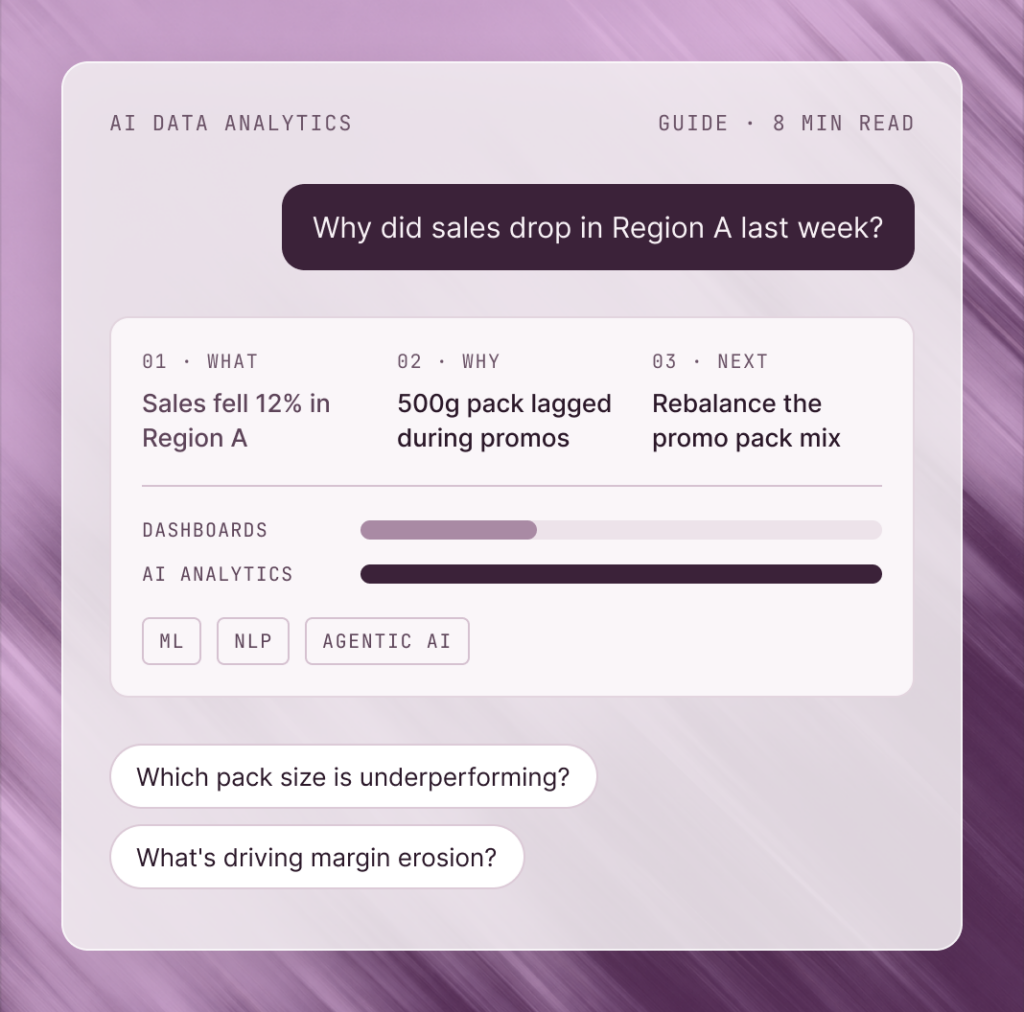
AI data analysis refers to the use of artificial intelligence — including machine learning and natural language processing — to allow users to interact with data conversationally and dynamically.
For non-technical teams, this means:
- Asking questions in plain English
- Getting immediate insights
- Getting immediate insights
- Running multi-variable analysis without writing code
- Exploring follow-up questions on the spot
Instead of building dashboards for every scenario, AI systems interpret questions and generate contextual analysis in real time.
How AI Empowers Non-Technical Teams
Conversational Querying
Instead of navigating filters and dropdowns, users can ask:
- “Why did revenue decline last month?”
- “Which store cluster is underperforming?”
- “Compare pack size performance in urban vs rural areas.”
The system interprets intent and retrieves relevant data automatically.
This eliminates tool friction and reduces hesitation.
Contextual Explanations
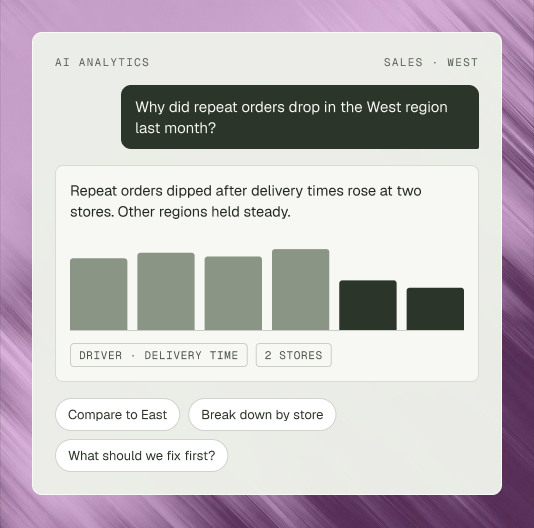
AI systems can explain trends in plain language.
Rather than showing a dip in sales and leaving interpretation to the user, AI can identify:
- Contributing regions
- Specific SKUs driving change
- Price fluctuations
- Promotion impacts
This bridges the gap between data visualization and decision clarity.
Instant Follow-Up Exploration
Business thinking is iterative.
If you learn:
- Sales declined in Region A
Your next question might be:
- Which product categories were affected?
- Was there a pricing change?
- Did inventory levels drop?
AI supports this natural flow without restarting the analysis process.
Reduced Dependence on Data Teams
This doesn’t eliminate the need for analysts — it elevates them.
When non-technical teams can handle exploratory questions independently, analysts can focus on:
- Advanced modeling
- Predictive analytics
- Strategic planning
- Data governance
The organization becomes more efficient overall.
What to Look for in an AI Data Analysis Platform?
Not all AI data analysis platforms are created equal.
Many tools claim to offer “conversational analytics” or “AI-powered insights,” but the depth, reliability, and business impact can vary significantly. For non-technical teams especially, the wrong tool can create more confusion than clarity.
Here’s what to evaluate:
True Natural Language Understanding
Some platforms technically accept plain-language queries, but rely on rigid phrasing or predefined templates. If users must structure questions in very specific ways, the experience quickly becomes frustrating.
A strong AI data analysis platform should:
- Understand context, not just keywords
- Interpret vague or exploratory questions
- Handle follow-up queries naturally
- Maintain conversational memory within a session
Contextual Depth
Many tools can summarize data or generate charts. Fewer can investigate drivers.
Look for platforms that can:
- Identify contributing factors behind changes
- Analyze multiple variables simultaneously
- Compare performance across time, geography, or segments
- Detect anomalies automatically
- Provide reasoning alongside visualizations
Strong Data Governance and Metric Consistency
Empowering non-technical teams should not come at the cost of accuracy.
Without proper governance, AI tools can create:
- Conflicting metric definitions
- Misaligned KPIs
- Unauthorized data exposure
- Confusion around calculations
Evaluate whether the platform:
- Respects existing data permissions
- Aligns with your centralized metric definitions
- Logs queries for auditability
- Provides transparency into how calculations are derived
Trust is foundational. If users doubt the numbers, adoption will stall.
Explainability and Transparency
AI systems should not function as black boxes.
Non-technical teams need to understand:
- Where the data came from
- How metrics were calculated
- What assumptions were applied
- Why a specific insight was surfaced
Explainability increases confidence and reduces the risk of misinterpretation. It also allows users to validate insights rather than passively accept them.
A good platform should show its analytical logic clearly — especially when making recommendations or surfacing anomalies.
Integration with Existing Infrastructure
AI data analysis should enhance your ecosystem, not disrupt it unnecessarily.
Before adopting a platform, assess:
- Does it integrate with your ERP, CRM, and data warehouse?
- Can it complement existing BI tools?
- Does it require a full rebuild of your analytics stack?
The most practical AI systems work alongside traditional dashboards, rather than forcing a complete overhaul.
This reduces implementation friction and accelerates ROI.
Final Thoughts
At its core, an AI data analysis platform should reduce friction between curiosity and clarity.
If users still hesitate to ask questions, if insights still require multiple intermediaries, if analysis still feels rigid or intimidating, then the tool isn’t solving the core problem.
The right platform empowers non-technical teams to explore confidently, make informed decisions quickly, and collaborate more effectively without compromising governance or analytical depth.
That balance is what separates truly transformative AI data analysis from surface-level automation.